
Product · IPS-IN
Custom Die-Cut & CNC Inserts
This is the engineered heart of what IPS does: cavity inserts designed around your exact product, so it arrives seated, protected, and presented. Our engineers work from your CAD, drawing, or a physical sample — cavity layout, material, density, and clearances are calculated, then proven with a cut sample before production.
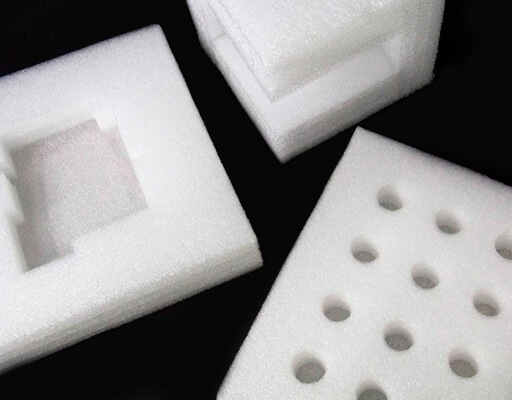
CNC wire cutting builds complex cavities with no tooling — ideal for development and low volumes — while steel-rule die cutting drives per-piece cost down at scale. Most programs start on CNC and graduate to a die when volumes justify it; the die charge is one-time and waived on reorders.
What you get
- Engineering from CAD, drawings, or physical samples
- CNC wire cutting — no tooling, fast revisions
- Die cutting for volume economics
- Multi-layer and multi-density builds
- PE, XLPE, EVA, PU, and anti-static PE
- Physical sample approval before production
Specifications
| Part series | IPS-IN — dims encoded in tenths of an inch |
| Block sizes | Up to 48" × 96" footprint; laminated thicknesses |
| Cavity work | CNC wire cut (no tooling) or steel-rule die |
| Materials | PE, XLPE, EVA, PU (plain/convoluted), APE anti-static |
| Tooling | Die and CNC programming charges one-time, waived on reorders |
Typical applications
Frequently asked questions
What do you need from me to design an insert?
Any one of: a CAD file (STEP preferred), a dimensioned drawing, or the physical product — plus the case or box it rides in and how it ships. Engineering and the first design pass are free with a quote.
Die-cut or CNC — which is right for my volume?
Under roughly 1,000 pieces or while the design is still changing, CNC wins (no tooling). Above that, a steel-rule die usually pays for itself quickly. We quote both crossover points for you.
Can inserts combine two foams?
Yes — common builds pair a soft PU or convoluted top layer with a firm PE base, or an anti-static contact layer over economical EPE. Laminated multi-density builds are routine.