
Material · EPS
Expanded Polystyrene (EPS)
EPS carries the big stuff: rigid blocks, corners, and rails that position appliances and electronics inside their cartons and take the stacking load off the product. It's the lightest and most economical foam per protected volume, and hot-wire cutting shapes it fast.
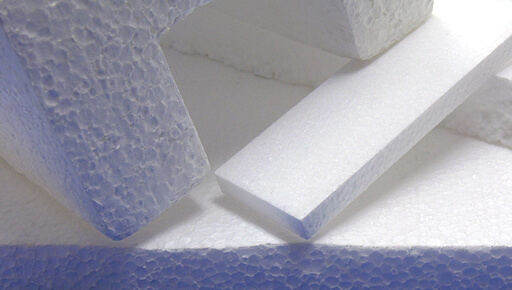
Beyond packaging, the same boards insulate — construction panels and cold-chain boxes run on EPS economics.
Properties
| Cell structure | Closed cell, molded beads |
| Typical densities | 1 – 3 pcf |
| Rigidity | High — holds shape under stacking loads |
| Weight | Ultra-light; ~98% air |
| Fabrication | Hot-wire cut blocks, boards, and shapes |
Why choose it
- Lowest cost per protected volume
- Rigid positioning under stacking loads
- Thermal insulation value
Best for
Appliance corner blocks and railsTV and electronics end capsInsulation panels and cold-chain boxes
Frequently asked questions
EPS or PE for my pack?
EPS positions and carries stacking loads at the lowest cost, but it's single-impact — it crushes to absorb energy. PE recovers and protects through repeated handling. Big one-way shippers use EPS; reusable and multi-hit packs use PE.
Can EPS be cut to custom shapes?
Yes — hot-wire cutting produces blocks, rails, corners, and contoured shapes from CAD quickly and without tooling.