
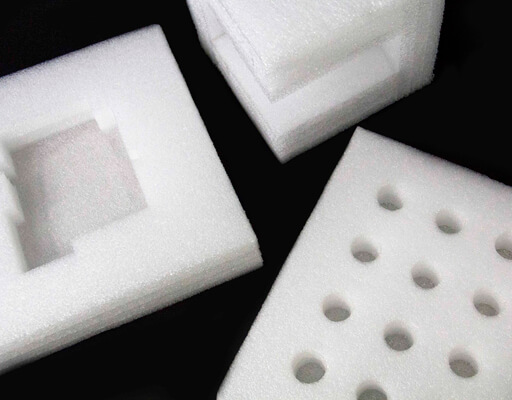
Most foam comparisons are about surviving a drop. This one is about what happens when the foam touches something that can't be marked, or something a customer will open and look at. Three materials cover that ground — cross-linked polyethylene (XLPE), EVA, and expanded polyethylene (EPE) — and each solves a different problem.
XLPE: fine cells, clean cavities
Cross-linking gives polyethylene a finer, tighter closed-cell structure. The result is a smooth, non-abrasive, low-particulate surface that won't mar painted or polished parts, and that routes and skives to crisp cavity walls. Typical densities run 2–6 pcf, in white, black and gray, with other colors by volume. It's the step-up material for medical device trays, class-A automotive surfaces, and case inserts where the foam is part of the product experience.
EVA: dense, tactile, built for daily use
EVA is the foam customers touch on purpose. It is dense (typically 4–12 pcf), firm and rubbery, and its cut edges resist fraying and wear through years of opening and closing. That makes it the material of tool shadow boards, retail and demo kits, and technician cases. Black is standard; colored layers laminated under a black top make every empty cavity visible at a glance, which is the basis of tool control programs.
EPE: protection against contact, not impact
EPE is the lightweight of the PE family: soft, flexible, non-abrasive, typically 0.9–1.7 pcf, and the lowest cost per protected surface area. Where PE plank protects against impact, EPE protects against scuffs, scratches and rub-through on finished surfaces. It is the foam layer in our laminated corrugated, a wrap for furniture panels, and an economical pad between stacked goods.
Side by side
- XLPE: fine closed cell, 2–6 pcf, smooth low-particulate surface — best for medical trays and class-A or polished parts
- EVA: fine closed cell, 4–12 pcf, firm and rubbery — best for presentation kits, shadow boards and high-wear cases
- EPE: expanded closed cell, 0.9–1.7 pcf, soft and flexible — best for surface wraps, void fill and laminated pads
How to choose
- Foam touches a surface that can't be marked, or particulate matters: XLPE
- The insert is opened daily or has to look finished: EVA
- The risk is scuffing, and cost per square inch drives the decision: EPE
- Hidden industrial cushioning with no cosmetic requirement: standard PE does the job for less
These materials also combine. EPE against the surface with PE at the corners is a common pairing, and multi-color laminated XLPE or EVA builds are routine for tool control and presentation inserts. IPS fabricates all three in-house and cuts inserts by die-cut or CNC wire-cut from your CAD, with physical samples before production. Send the part to the quoting tool and we will spec the material with you.