
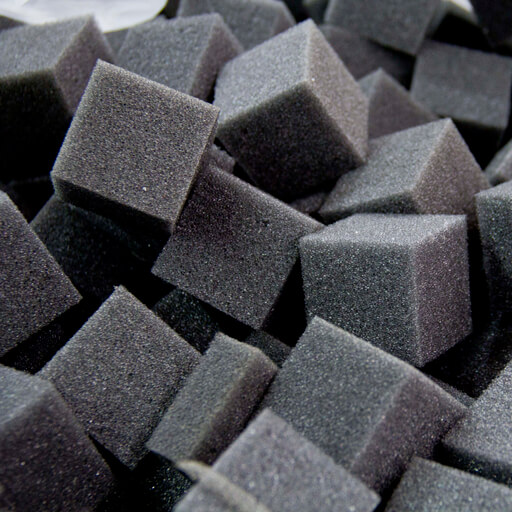
Most protective packaging decisions come down to three materials: polyethylene (PE), polyurethane (PU), and expanded polystyrene (EPS). They look similar on a spec sheet — all light, all cushioning — but they fail in completely different ways, and picking the wrong one is how products arrive broken inside intact boxes.
Polyethylene: the multi-impact workhorse
PE is a closed-cell foam: millions of sealed air pockets that compress under impact and spring back. That recovery is its defining property — a PE pack protects on the first drop and on the tenth. It doesn't absorb water, doesn't crumble, and machines cleanly into corner protectors, edge guards, and cavity inserts. If your product is medium-weight and ships through normal parcel or LTL abuse, PE is the default answer.
Polyurethane: the soft catcher
PU is open-cell — air moves through it, so it compresses with almost no resistance and cradles very light, very fragile items: optics, ceramics, instruments. The same softness is its limit. Put a heavy product on PU and it bottoms out, transmitting the shock straight through. Keep PU for products under a few pounds, or as a soft top layer over a firmer PE base.
EPS: rigid economics for one trip
EPS — molded polystyrene bead — is rigid, ultra-light, and the cheapest foam per protected volume. It positions appliances and TVs in their cartons and carries warehouse stacking loads that would slowly crush other foams. The trade-off: EPS absorbs a major impact by crushing, once. For single-trip shipments of big goods it's unbeatable; for reusable or multi-hit packaging, it's the wrong tool.
A 30-second selection framework
- Fragile and light (under ~5 lb): PU, plain or convoluted
- Medium weight, repeated handling, returnable: PE (or XLPE when surfaces can't be marked)
- Heavy, boxed, one-way, stacked in a warehouse: EPS
- Static-sensitive electronics: anti-static PE
- Presentation kits the customer opens: EVA or XLPE
Density matters as much as material: the same PE protects very differently at 1.7 pcf and 6 pcf. That's a static-loading calculation — product weight over bearing area — and it's exactly the work our engineers do free with any quote. Send the part, get the spec.