
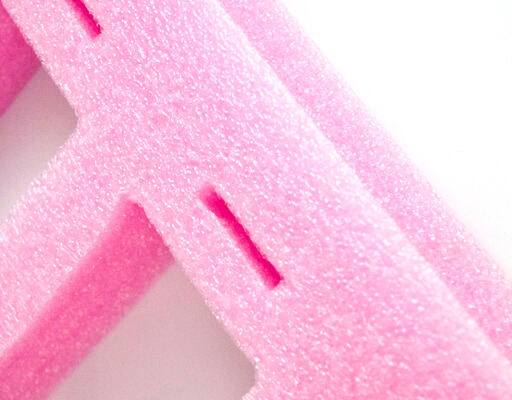
Electrostatic discharge is the failure you never see happen. A board slides against ordinary foam, picks up a few thousand volts of triboelectric charge, and a junction dies — not visibly, not immediately, but weeks later in the field. Packaging is either part of the ESD control program or it's a hole in it.
What anti-static foam actually does
Anti-static PE is polyethylene treated so charge dissipates instead of accumulating as surfaces rub. It wears the industry's signature pink so anyone on a line can confirm at a glance that the packaging is ESD-safe. Mechanically it behaves like standard PE — same closed-cell cushioning, same fabrication — so trays, separators, and inserts spec the same way.
Anti-static vs. conductive: not the same thing
Anti-static (dissipative) foam prevents charge generation and bleed-off — right for boards, modules, and finished devices. Conductive foam (black, carbon-loaded) creates a grounded path, traditionally for shorting component leads together. Most packaging needs the pink, not the black; mixing them up wastes money at best.
Speccing ESD trays that production actually uses
- Cavity per board, not bulk-pack: sliding contact is what generates charge
- Stackable trays with locating features speed kanban counts
- Anti-static top layer over economical EPE base cuts cost on thick builds
- Plan tray replacement cycles — surface treatments deplete over years of handling
For the Tijuana–San Diego electronics corridor, we fabricate anti-static trays and inserts locally: engineering from your board CAD, samples before production, and kanban releases delivered to the line — no border in the loop for Baja plants.